
See our affiliate disclosure for details.
When you’re starting affiliate marketing, it’s easy to think your first job is finding affiliate programs.
It isn’t.
Your first job is eliminating the wrong ones.
That sounds backwards, especially when you’ve found a list of promising programs and each one appears to offer a legitimate product, a commission opportunity, or an established brand. The natural reaction is to join several of them so you have more things to promote.
That approach creates a problem beginners often don’t see until later: having more affiliate programs doesn’t automatically give you more opportunities. It can give you more decisions, more products to learn, more links to manage, and more content you feel responsible for creating.
A better approach is to treat every affiliate program as a candidate that has to earn its place.
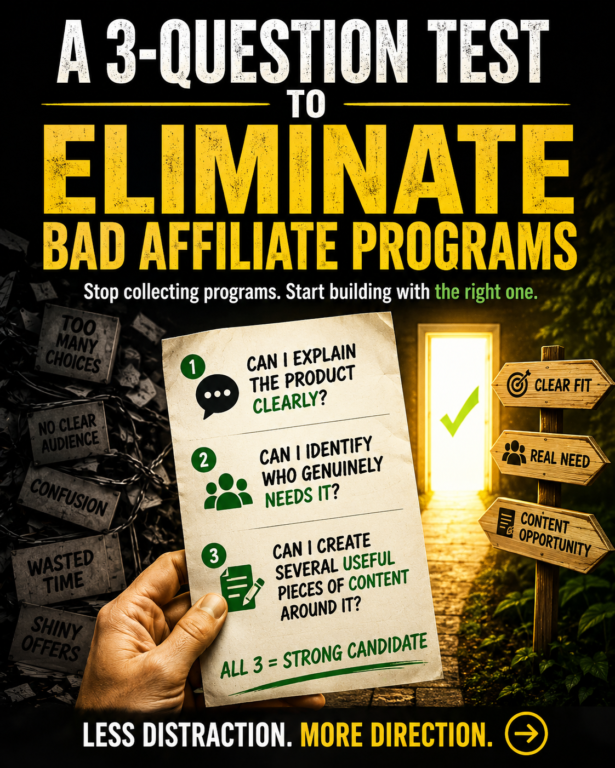
Before joining one of the programs you’re considering, ask three questions:
Can I explain the product clearly?
Can I identify who genuinely needs it?
Can I create several useful pieces of content around it?
If you can’t answer all three reasonably well, the program probably shouldn’t be a priority right now.
This isn’t a test of whether a product is “good.” It’s a test of whether you have a workable foundation for promoting it.
That’s an important distinction.
The Product Can Be Good and Still Be Wrong for You
Affiliate beginners sometimes evaluate products almost entirely from the merchant’s perspective.
Does the company look established?
Does the product seem useful?
Is the commission attractive?
Does the affiliate program have marketing materials?
Those questions aren’t useless, but they don’t answer the question that matters most to the beginner:
Can I build useful content around this product for a specific audience?
Imagine you discover two affiliate programs.
The first sells a software product with features you don’t fully understand. The commission looks attractive, and the company provides banners, email copy, and promotional graphics.
The second sells a service you’ve personally used. You understand what it does, what problem it addresses, who might benefit from it, and the questions a beginner is likely to ask before purchasing.
The first program might have excellent economics.
The second may give you a much better starting point.
Why?
Because affiliate marketing isn’t simply the act of placing a link in front of someone. Someone has to become interested enough to consider the product, understand why it might help, trust the recommendation, and decide whether it’s appropriate for their situation.
Useful content can help with that process.
If you don’t understand the product well enough to teach it, you’re starting with a handicap.
This is why the three-question test begins with explanation, not commission.
Question One: Can I Explain It Clearly?
Try explaining the product without using the company’s marketing language.
Don’t repeat its tagline.
Don’t read its feature list.
Don’t say it is “innovative,” “powerful,” or “easy to use” unless you can explain exactly what those words mean in practical terms.
Instead, answer four simple questions:
What is it?
What problem does it address?
How does someone actually use it?
What might make someone hesitate before buying it?
If you can answer those questions in ordinary language, you’re beginning to understand the product well enough to teach around it.
If you can’t, that’s a signal.
It doesn’t necessarily mean you should reject the program permanently. It may mean you need to learn more before promoting it.
This distinction matters because you don’t need to know everything about a product, but you need to know enough to be useful.
A senior beginner considering an email marketing service, for example, doesn’t necessarily need a technical explanation of every feature. They may want to know how the service helps them collect subscribers, send emails, organize contacts, or communicate with potential customers.
If you understand those practical questions, you have something to teach.
If all you know is that the service offers “advanced automation,” you don’t have content yet. You have a phrase from a sales page.
That leads directly to the second question.
Question Two: Can I Identify Who Genuinely Needs It?
A product can’t be useful to “everyone.”
Even when the company markets it broadly, your affiliate content becomes stronger when you can identify a particular person, problem, or situation where the product makes sense.
For a senior audience, this can be especially useful.
Suppose you’re evaluating an affiliate program for a website-building service.
You could create generic content saying, “This is a great website builder for anyone starting an online business.”
Or you could identify a much more specific situation:
A 62-year-old beginner wants to start a small online business but doesn’t have technical experience and doesn’t want to learn web development before publishing a basic website.
Now you have a person, a situation, and a problem.
That gives you much better questions to explore.
What does this person actually need from a website?
Which features matter to a beginner?
What can they ignore initially?
What might confuse them?
What would make the setup feel manageable?
Those questions can become useful content.
The key distinction is this:
A product can have a broad market, but your content needs a specific reason for being relevant.
That’s why “Who needs this?” is more useful than “Who could buy this?”
Almost anyone could buy many products.
That doesn’t mean you should build your content around them.
A person genuinely needs something when you can describe the situation that creates the need.
For example, someone might not wake up thinking, “I need an email automation platform.”
They may think:
“I have people signing up for my free guide, but I’m manually sending messages.”
Now there’s a problem to solve.
That problem may lead naturally to a category of products, including an affiliate product you’re promoting.
This changes how you approach affiliate content. Instead of starting with the product and trying to convince people they need it, you can start with a problem and determine whether the product is a reasonable solution.
That makes the recommendation more useful and gives you a clearer editorial direction.
Question Three: Can I Create Several Useful Pieces of Content Around It?
This is the question that exposes a surprising number of weak affiliate choices.
A product might be understandable.
It might have an identifiable audience.
But if you can only imagine one article about it, you may not have much of a content opportunity.
Before joining a program, try a simple exercise.
Without looking at the company’s promotional materials, write down at least five useful content angles related to the product.
Not five advertisements.
Five things someone could genuinely learn.
For a website-building service aimed at older beginners, you might come up with:
How to choose what pages a new business website actually needs
The mistakes beginners make when trying to build a website
How to decide whether a website builder is suitable for a nontechnical user
What to prepare before building your first website
How to turn a basic website into a useful home base for your online business
Notice what happened.
The product stopped being the entire topic.
Instead, it became connected to a larger collection of problems and decisions faced by the intended audience.
That’s the real opportunity.
A strong affiliate program can function as a content anchor.
You don’t need to mention the affiliate product in every piece. In fact, useful content often becomes stronger when the teaching comes first and the product appears only when it genuinely fits the problem being discussed.
This gives you room to educate rather than constantly promote.
And that matters because people usually have questions before they have buying intent.
Someone who is researching how to start an online business may not be ready to purchase a website service today. But if your content helps them understand what they need, what choices they have, and what mistakes to avoid, you’ve created something useful before the buying decision arrives.
The Three Questions Working Together
The real power of the test isn’t in the questions individually.
It’s in the intersection.
Consider a hypothetical senior beginner named Linda.
Linda wants to build an online business around something she already knows well. She’s considering an affiliate program for an email marketing platform.
Can she explain it?
Yes. She understands that the platform helps her collect email subscribers and communicate with them without manually contacting every person.
Can she identify who genuinely needs it?
Yes. She can identify beginners who are building an audience and want a way to stay in contact with people who request their free resources.
Can she create several useful pieces of content around it?
Yes. She could teach how to start an email list, what to send new subscribers, how to create a simple welcome sequence, what mistakes beginners make when collecting subscribers, and how to decide what email tools they actually need.
That program passes the test.
Now imagine another program.
Linda finds a technical software product with a higher commission. She understands that businesses use it, but she can’t explain the product without copying the company’s terminology. She isn’t sure which specific beginners need it, and after brainstorming, she can think of only one article she could realistically write.
That program fails.
It may still be an excellent product.
It may have satisfied customers.
It may even be more profitable for someone with a different audience and skill set.
But it’s not necessarily a good affiliate choice for Linda right now.
That’s the part beginners often miss.
The test isn’t judging the affiliate program.
It’s judging the fit between the program, the marketer, the audience, and the content.
Turn the Test Into a Decision Rule
You can make this even simpler.
Before joining an affiliate program, complete these three sentences:
I can explain this product as…
The person most likely to need it is…
I could teach people about…
Then finish the third sentence with at least five genuinely useful topics.
If you get stuck on the first sentence, learn more about the product.
If you get stuck on the second, reconsider the audience fit.
If you get stuck on the third, reconsider the content potential.
And if you struggle with all three, don’t rationalize the decision because the commission looks attractive.
Put the program aside.
You haven’t lost an opportunity. You’ve eliminated a distraction.
That distinction can save a beginner from building an affiliate business around a collection of unrelated products.
The goal isn’t to collect affiliate programs.
The goal is to find products you can understand, connect to a real audience problem, and teach about repeatedly.
That’s the three-question test.
Before you join any program from your list of potential affiliate opportunities, ask:
Can I explain it clearly? Can I identify who genuinely needs it? Can I create several useful pieces of content around it?
If the answer is yes to all three, you have a candidate worth investigating further.
If the answer is no to one or more, you’ve learned something valuable before spending your time promoting it.
And that may be the most useful shift of all: stop asking which affiliate programs you can join and start asking which programs deserve your attention.
Try This With AI
Use the AI you’re already using: ChatGPT, Claude, Gemini, Grok, Meta AI, Copilot, or another general-purpose AI assistant. Replace the example information inside the brackets with your own information, then copy and paste the complete prompt into your AI.
AI Prompt
Act as an affiliate-program fit evaluator. Analyze the affiliate program, product, or service I provide and determine whether it deserves my attention as a beginner affiliate marketer. Apply this three-question test: 1) Can I explain the product clearly in ordinary language, including what it does, the problem it addresses, how someone would use it, and likely reasons for hesitation? 2) Can I identify who genuinely needs it by describing a specific audience situation or problem that creates the need, rather than simply identifying people who could buy it? 3) Can I create at least five genuinely useful pieces of educational content around it without turning every piece into an advertisement? Based only on the information I provide and reasonable inferences you clearly label as inferences, evaluate each question, identify the strongest evidence and any gaps, suggest five realistic content angles if the program passes the content test, and give me a final verdict of Strong Candidate, Needs More Research, or Poor Fit Right Now. Explain the reasoning behind the verdict and identify the single biggest factor that should influence my decision. Don’t invent product features, commissions, audience demand, results, testimonials, statistics, or other unsupported facts. [PASTE OR DESCRIBE THE AFFILIATE PROGRAM OR PRODUCT YOU’RE CONSIDERING, INCLUDING ANY INFORMATION YOU HAVE, SUCH AS: “An email marketing platform for small businesses that lets users collect subscribers, send emails, and create automated welcome sequences.”]
Did you like this? Then 'like and share' it with others.

Reg Ervin
