

See our affiliate disclosure for details.
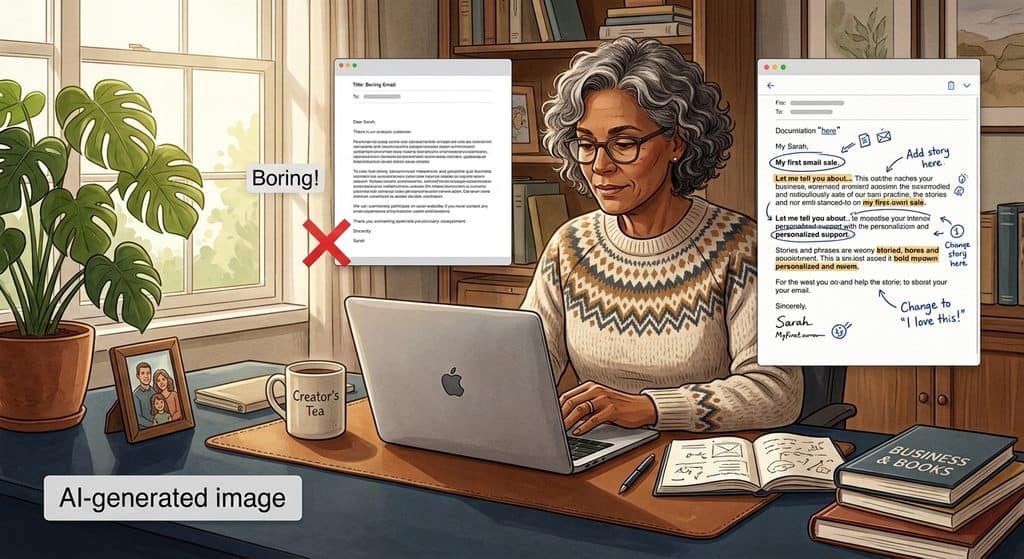
Most seniors who try AI for their online business make the same quiet mistake. They ask for an email, get something clean and pleasant, and then spend twenty minutes fixing it.
The fixes feel random. Swap this word, cut that sentence, add a line that sounds like them.
The draft isn’t wrong. It’s average. AI writes toward the middle of everything it has seen, so it produces the voice of nobody in particular.
A younger marketer who sells on novelty might get away with that. If your advantage is thirty years of earned trust, generic writing is expensive. Your experience is the reason people would buy from you, and a bland draft hides it.
You also can’t fix this by telling AI to “sound warm and professional.” Adjectives describe. They don’t instruct. Every tool already believes it’s being warm and professional.
What it needs are patterns that are specific and checkable, pulled from how you actually write.

Generic writing hides earned trust
A good style guide isn’t a portrait of how you sound. It’s a list of what you’d catch and fix in anyone else’s draft.
Three ridges in every voice
A fingerprint isn’t one feature. It’s a set of ridges that mean something together. Your writing has three that matter here.
Rhythm
Rhythm is how your sentences are built. Do you write short, then shorter? Do you open with the point or with the backstory? Do your paragraphs run one sentence or five? Do you ask questions mid-email?
Reflexes
Reflexes are the words and phrases you reach for without thinking. Just as important are the ones you’d never touch.
You might say “here’s where I’d start” and never write “I hope this email finds you well.” Your refusals are often stronger signals than your habits.
Returns
Returns are the things you keep coming back to. They include the story about the first client who walked away, the analogy you use to explain pricing, and the stance you hold that discounts train customers to wait.
Returns are your opinions and your stories. They’re what make a longtime reader think, “That’s so like him.”
Most people only notice rhythm, and only when it’s wrong. Reflexes and returns are where trust actually lives, because they show judgment, not just style.
A reader can forgive a clunky sentence. They won’t stay loyal to a voice that never takes a position.
Here’s the line worth keeping. A good style guide isn’t a portrait of how you sound. It’s a list of what you’d catch and fix in anyone else’s draft.
What it looks like when someone does the work
Picture a former sales manager. Call him Dale. He’s launched a small online consulting offer for local contractors, and he’s frustrated.
Every AI draft of his follow-up emails reads like a brochure. He knows it’s off but can’t say why.
So he stops prompting and starts reading. He pulls three real emails he wrote years ago and sent to real people.
One went to a customer who’d gone quiet after a quote. One thanked a client for a big order. One pushed back politely on a request for a steep discount.
Then he lays them side by side and asks one question of each. What would I never change?
Here’s what he finds.
All three open with the other person’s situation, never with himself. “Sounds like the framing crew pushed your schedule” comes before anything about what he wants.
His sentences rarely run past fifteen words, but he drops in one long sentence at the key moment, usually the one explaining why something matters.
None of the three uses “just checking in.” In the quiet-customer email, he names the silence plainly. “Haven’t heard back, which usually means the timing’s off or the price is.”
That’s a reflex. It also happens to be the reason the email works.
Every email ends with exactly one question, never two.
In two of the three, he mentions the same story about a job lost over a four-hundred-dollar difference that cost the client six thousand later.
That’s a return. It’s his proof that he understands price versus cost, and he never states that claim directly.
Dale turns those findings into instructions, not descriptions. He doesn’t write “friendly and direct.”
He writes:
Open with the reader’s situation in the first sentence. Keep sentences under fifteen words except the one explaining why it matters. Never use “just checking in” or “hope you’re well.” Name the silence or the objection plainly. End with one question. When discussing price, a short story about cost versus price is allowed, but only one per email.
He pastes those rules and two of the original emails into his AI tool, and the next draft sounds like him.
It isn’t perfect, but now his edits are small. He’s fixing details, not rebuilding a stranger’s email.
Notice what made the difference. Dale didn’t need a better prompt. He needed better evidence about himself.
The three-sample rule
Dale’s method works because of how he filtered. He didn’t turn every quirk into a rule.
A pattern only earned a place in his guide if it showed up in at least two of three samples and he’d defend it.
That filter matters because you’ll find false fingerprints. Maybe you overused “honestly” in one email because you were tired. That’s a tic, not a trait.
A real fingerprint repeats across moods, audiences, and years. A tic repeats inside one afternoon.
Use this as a quick sorting test for anything you find.
Does it appear in at least two or three samples written at different times?
Would a longtime customer notice if it were missing?
Would you defend it if someone told you to change it?
Three yeses make it a rule. One yes makes it a note. Zero makes it noise.
You can also run a cover test on your results. Take an AI draft written with your guide, strip the name off, and hand it to someone who knows you.
If they can’t tell it’s yours within a few lines, the guide is describing your style but not capturing it. Go back and look for the refusals and the returns. Those are usually what’s missing.
Where this goes wrong
Two warnings, both practical.
First, don’t write the guide from memory. People describe themselves as they wish they wrote.
Dale might have claimed he’s “concise” when the emails show a man who tells a story whenever it counts. Samples don’t flatter you, which is why they work.
Second, a style guide followed too literally becomes a costume. If AI uses your favorite phrase in every email, readers will spot it quickly.
Give each reflex a limit. “Here’s where I’d start” is allowed once per message, and the price story appears only when price is actually the topic.
So the working rule is this. Collect three real samples, look for what you’d never change, and write each pattern as an instruction with a limit.
Your voice isn’t what you sound like. It’s what you’d refuse to let someone else do to your sentences.
Once you’ve captured the email version of you, a harder question shows up. Does the same fingerprint hold in a sales page, a short social post, or a message to an unhappy customer?
Most people find their voice shifts in each of those, and the ridges that stay constant across all of them are the real core of how they come across.
Try This With AI
Use the AI you’re already using: ChatGPT, Claude, Gemini, Grok, Meta AI, Copilot, or another general-purpose AI assistant. Replace the example information inside the brackets with your own information, then copy and paste the complete prompt into your AI.
AI Prompt
Act as a writing analyst who builds voice style guides from real evidence. Below are two or three real emails or posts I wrote at different times for my online business: [paste 2 or 3 of your real writing samples here, for example: “Email 1: Sounds like the framing crew pushed your schedule. Haven’t heard back, which usually means the timing’s off or the price is. Want me to hold your spot through Friday? / Email 2: Thanks for the big order. Here’s where I’d start on delivery… / Email 3: I hear you on the discount. A few years back I lost a job over a four hundred dollar gap…”]. Study them closely and don’t flatter me or describe how I wish I wrote. Look for three kinds of patterns. Rhythm covers sentence length, how I open and close, paragraph size, and use of questions. Reflexes cover phrases and words I reach for, and just as important, phrases I clearly avoid. Returns cover stories, analogies, and opinions I come back to. Keep only patterns that show up in at least two samples, and list anything that appears once as a “note” rather than a rule. Flag likely tics, such as a word overused in one sample only, and explain why you think it’s a tic. Then write my style guide as 8 to 12 direct, checkable instructions an AI could follow, each with a limit so my voice doesn’t become a costume, for example “use this phrase once per message” or “tell this story only when price is the topic.” Next, run the three-question test on every rule: does it repeat across samples, would a longtime reader notice if it were missing, and would I likely defend it. Show a short pass or fail for each. Finish with a single paragraph I can paste at the top of any future AI request, containing my rules, and name the one pattern you’re least sure about so I can confirm it. Label any inference as an inference, and don’t invent details about me that the samples don’t support.
Did you like this? Then 'like and share' it with others.

Reg Ervin
