
See our affiliate disclosure for details.
One of the most overlooked problems with building an online side hustle during retirement isn’t figuring out how to make something people will buy. It’s figuring out how to avoid creating a business that constantly demands something new from you.
At first, the idea sounds reasonable. Create a helpful post. Then another. Make a digital product. Then another. Record a video. Send an email. Create a new freebie. Update the website. Find another topic. Repeat.
Eventually, the side hustle starts behaving like a job.
That’s a problem if the reason you’re building an online side hustle is to create more flexibility, not another schedule you have to maintain.
The better question isn’t, “What can I create next?”
It’s, “What can I create once that can continue being useful?”
That small change in thinking can completely alter the type of online side hustle you build.
Stop measuring productivity by how much you create
A common assumption in online business is that productivity means producing more.
More articles.
More social posts.
More videos.
More products.
More emails.
More offers.
There’s nothing inherently wrong with creating content consistently. But consistency becomes a problem when the business model depends on your ability to produce something new every time you want the business to remain useful.
For a retiree, that’s an important distinction.
You may have decades of knowledge, practical experience, hobbies, professional skills, or lessons learned from solving real problems. The goal shouldn’t necessarily be to turn all of that into an endless stream of new material.
Instead, think of your knowledge as raw material that can be converted into reusable assets.
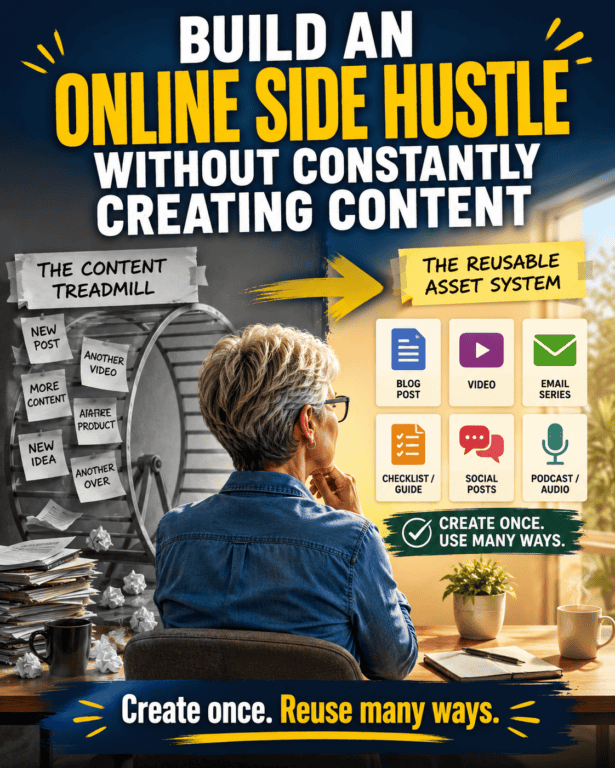
A reusable asset is something you create once and can use repeatedly without rebuilding it from scratch each time.
A practical guide can become a free download.
That guide can introduce an email sequence.
The email sequence can point readers toward a related product.
The same ideas can become several social posts.
A checklist can become part of a paid report.
A short tutorial can support a product for months.
The important thing isn’t that one piece of content magically produces income forever. It won’t. The important thing is that one useful piece of work can perform several jobs.
That’s a much more sustainable way to think about a side hustle.
Here’s the distinction worth remembering:
A content treadmill requires you to keep producing value. A content asset lets previously created value keep doing work.
That doesn’t mean you never create anything new. It means new creation becomes an improvement to the business rather than the fuel required to keep the entire business alive.
The Reuse Test
Before creating anything for your online side hustle, run it through a simple test.
Ask four questions:
1. Can I use this more than once?
If the answer is no, ask whether it’s worth the time required to create it.
A social media post may have limited reuse by itself. A detailed checklist that answers a recurring problem has much greater reuse potential.
2. Can this solve more than one problem?
The strongest assets often have multiple uses.
For example, suppose you’ve spent years working in an office and know how to organize digital files, manage documents, and keep track of information.
You could write a single guide called “A Simple Digital Organization System for Beginners.”
That could become a downloadable guide, an email series, a workshop outline, a checklist, several social posts, and the foundation for a paid product.
You didn’t create six things.
You created one useful thing that can be repurposed six ways.
3. Can another part of my business point to it?
A reusable asset becomes more valuable when other content can lead people toward it.
An article can reference it.
An email can recommend it.
A social post can demonstrate one part of it.
A free resource can introduce it.
A paid product can expand upon it.
This creates a connected system instead of a collection of unrelated content.
4. Does it become more valuable when I add experience?
This is particularly important for older entrepreneurs.
Your advantage isn’t necessarily knowing the newest online marketing trick. Your advantage may be knowing how to solve practical problems because you’ve already spent years solving them.
That experience can make your digital assets more useful.
A generic “how to start an online business” article is easy to produce and easy to forget.
A practical guide that explains how to choose an online side hustle when you have limited technical experience, don’t want to work full time, and already possess valuable professional knowledge is much more specific.
The second asset has a clearer reason to exist.
A senior side-hustle example
Imagine a retired factory worker who spent 30 years learning how to troubleshoot equipment, train new employees, document procedures, and solve problems under pressure.
He decides he wants an online side hustle.
The obvious approach might be to search for a popular online business model and start producing content about it.
But that starts the business from the wrong end.
Instead, he could ask, “What problems do I already know how to solve?”
Perhaps he knows how to teach complicated procedures in simple language.
That’s valuable.
He could create a practical guide showing small business owners how to document repeatable procedures for new employees.
That one asset might include a simple procedure template, an example, a checklist, and instructions for using the template.
Now consider what happens next.
The procedure template can be offered as a standalone download.
The guide can become a low-cost digital product.
The checklist can become a lead magnet.
The lessons from the guide can become email content.
Individual sections can become social posts.
A more advanced version could become a larger product.
The retiree isn’t starting over every Monday morning trying to figure out what to create.
He’s building around a useful piece of intellectual property.
That’s the mechanism many new online entrepreneurs miss.
They think the business is the content.
The content is actually one of the ways people discover, understand, and eventually buy the underlying solution.
Once you see that distinction, you can make different decisions about what deserves your time.
Use the Asset-First Question
Before spending several hours creating a new piece of content, ask:
“If I finish this today, what else can it become?”
If the answer is “one social media post,” that’s not automatically bad. Sometimes a post is exactly what you need.
But if every piece of work has only one use, you’re creating a business that requires continuous production.
If the answer is “a guide, checklist, email sequence, product section, video outline, and several social posts,” you’ve found something much more valuable.
You’re creating an asset.
This also gives you a practical way to evaluate online side-hustle ideas.
Don’t just ask:
“Can I make money doing this?”
Ask:
“Can I build useful assets around this?”
That’s a better question because income potential isn’t the only consideration when you’re building a side hustle for retirement.
You also have to consider the maintenance burden.
Two businesses could generate similar revenue while requiring dramatically different amounts of ongoing creation.
One might require you to publish new material constantly.
The other might rely more heavily on a library of useful resources, automated emails, evergreen offers, affiliate recommendations, digital products, or other assets that continue serving the same audience.
Neither model is automatically better.
The better model is the one that matches the life you actually want.
That’s the part many side-hustle discussions overlook.
A business model isn’t successful simply because it can generate income. It’s successful for you when the way it generates income fits the constraints and priorities you have.
If you want retirement to remain flexible, your available time is part of the business model.
So is your willingness to learn technology.
So is your tolerance for constant content creation.
So is whether you enjoy being on camera, writing every day, selling products, answering customers, or managing multiple platforms.
These aren’t minor personal preferences.
They’re operating constraints.
Ignoring them can cause you to choose a business that looks attractive on paper but becomes exhausting in practice.
The most useful rule is simple:
Don’t build an online side hustle that needs your constant output when what you really want is flexibility. Build a collection of useful assets that can be reused, connected, and improved.
That doesn’t eliminate work.
It changes the kind of work you’re doing.
Instead of asking what you have to create today to keep the business alive, you’re asking what valuable asset you can create today that will make tomorrow’s work easier.
That is a much better trade for someone building an online side hustle during retirement.
So before you choose your next product, article, video, or social post, pause.
Don’t ask whether you can publish it.
Ask whether you can reuse it, connect it, expand it, or turn it into something else.
If you can’t see at least one additional use, question whether it’s the best use of your limited time.
If you can see several, you’ve probably found something worth building.
The goal isn’t to create less value.
It’s to stop creating the same value over and over again.
Try This With AI
Use the AI you’re already using: ChatGPT, Claude, Gemini, Grok, Meta AI, Copilot, or another general-purpose AI assistant. Replace the example information inside the brackets with your own information, then copy and paste the complete prompt into your AI.
AI Prompt
Act as an online side-hustle asset strategist for older beginners. Analyze the idea, skill, experience, knowledge, or existing piece of content I provide and identify the strongest opportunity to turn it into one reusable digital asset that can serve multiple purposes without requiring me to constantly create something new. [PASTE OR DESCRIBE ONE THING YOU ALREADY KNOW, CAN DO, OR HAVE CREATED, INCLUDING A SHORT EXAMPLE SUCH AS: “I spent 25 years managing inventory for a small manufacturing company and became very good at creating simple inventory tracking systems. I also have a basic spreadsheet I used to track stock.”] From that input, determine the most practical reusable asset I could build, explain exactly what problem it would solve and for whom, then map how that single asset could be reused or connected across several parts of a simple online side hustle, such as a lead magnet, email content, social content, digital product, checklist, template, tutorial, or related offer. Prioritize options that reduce future content-creation workload, use my existing knowledge rather than requiring an entirely new skill set, and fit a flexible retirement lifestyle. Distinguish between genuinely reusable assets and content that would only create another recurring production obligation. Give me your strongest recommendation first, explain why it has the best reuse potential, show the practical reuse path, and finish with one clear first step I can take to create the asset. Treat anything you infer about my experience, audience, or potential demand as an inference rather than a fact, and don’t invent statistics, guarantees, testimonials, or income claims.
Did you like this? Then 'like and share' it with others.

Reg Ervin
